EMBROIDERY OFFICE / VEZNA KANCELARIJA >
LOCAL CRAFTS / LOKALNE RUKOTVORINE >
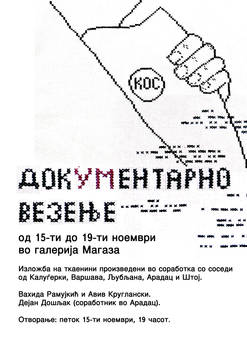
EXHIBITION IN MAGAZA / IZLOŽBA U MAGAZI>
Bitola is located in southwestern Macedonia, close to the borders with Greece and Albania, below the beautiful Pelister Mountain. It is also a city with a rich but turbulent history. Over barely 100 years—the second half of the nineteenth and the first half of the twentieth century—it went through a steep rise and an abrupt fall. As part of the Ottoman Empire in the late 1800s, it became an important regional centre, well known for the numerous consulates established there and for its military school. At the time, the presence of European representatives created a rich mixture of Eastern and European cultures. The city’s style was distinguished by “à la turca” and “à la franca”.
At the beginning of the twentieth century, the decline of the Ottoman Empire and a wave of national liberation movements brought a series of wars—the Ilinden Uprising in 1903, the two Balkan Wars of 1912–1913 and, most importantly, the First World War, one of whose main fronts passed through the city. As a result, the importance of Bitola as a regional centre diminished greatly.
The multicultural character of Bitola was also significantly diminished, as different ethnic groups were forced to leave the city at various stages of this period—the Turkish population after the Ilinden Uprising in 1903 and the Jewish population in 1943. This history of conflict was briefly revived in the context of the Yugoslav wars, when a significant number of Albanians were forced to leave the city in 2001.
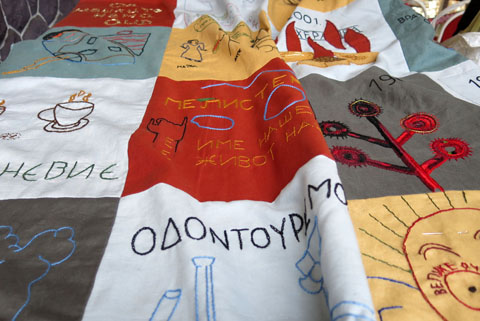
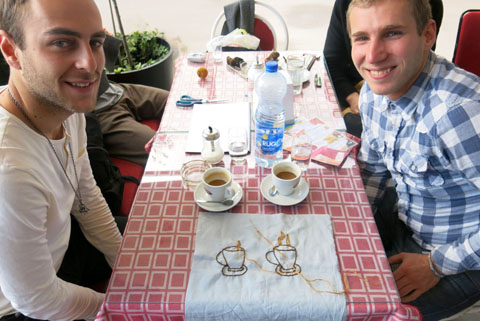
We opened our Embroidery Office in Jagoda, a local café where we embroidered every day from 10 a.m. to 2 p.m. The café was conveniently located near the History Museum, where we met Nade, who generously shared information about the textile history of Macedonia, different embroidery styles, their genealogy and meaning. The history of conflict is still very present in many of the stories we heard. For example, in a traditional pastry shop called Heraclea, highly recommended by friends, we met the original owner, now retired, who told us that his shop had been burned down during the conflicts of the 2000s. His story—of opening the shop as a young pastry chef, straight out of training; of its becoming a popular institution in Bitola; and of finally retiring after many years of struggle and leaving the shop to his son—was fascinating. He told it with a tired smile and a great deal of grace.
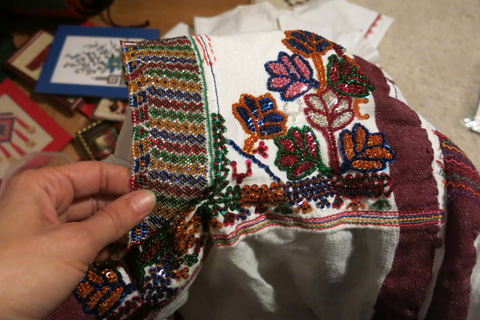
The traditional textile techniques of Bitola are fascinating and also carry stories that aroused our curiosity. One traditional element of Macedonian folk costume is the kjostik. It is a refined craft made with a fine crochet hook, beads and thin thread. This sculptural object, resembling an ornamented snake, was echoed in one of our embroideries. We found it interesting that during the uprising against the Ottoman Empire, when many men were sent to prison, making kjostik was one of the most common pastimes among prisoners.
Bitola was also the city in which the two Vlach brothers from Ioannina, Yanaki and Milton Manaki, chose to settle. While both are known as important documentarians of the Balkans during this period, the younger brother, Milton, is regarded as the first film documentarian in Balkan history.
It is also worth mentioning that in Bitola we visited the Museum of the Albanian Alphabet, the last bell-maker’s workshop in a street that still bears the name of the bell-makers, and a self-run brewery built next to the railway tracks.
We had the pleasure of meeting and working with many local people: Bujar, who accompanied us every day in Jagoda; Gordana, Tetka Ljilja and Ratka from the Association of Macedonian Handicrafts; Teresa, Jovanka and Romeo from the Asterion association; Filip Jovanovski, our local organiser, coordinating the Institute for Things That Can’t Be Learned; Goce, Oliver, Aleksandar and Dražen, who guided us through the history of the city; Katarina; Fotini and her boyfriend; Blagojče, who happily agreed to learn some stitches between his phone calls; Sašo Crazy; and many others.
MUSEUM VISIT WITH NADE / POSETA MUZEJU SA NADE >